
Analog-to-Digital Conversion
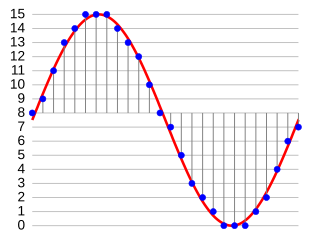
Analog-to-Digital Conversion (ADC) is the process of sampling a continuous analog signal (such as voltage from a microphone or sensor) at discrete time intervals and quantizing each sample into a digital binary code for processing by a computer or digital system. The two fundamental operations are sampling (governed by the Nyquist–Shannon sampling theorem) and quantization (introducing quantization noise proportional to resolution). ADCs are found in virtually all measurement systems, audio recording equipment, oscilloscopes, software-defined radios, and medical imaging devices.
Key Formula
Nyquist Sampling Theorem: Sampling frequency f_s ≥ 2 × maximum signal frequency f_max
LaTeX: f_s \geq 2 f_{max}
| Symbol | Meaning | Unit |
|---|---|---|
| f_s | Sampling frequency (samples per second) | Hz (Hertz) |
| f_max | Maximum frequency component in the analog signal | Hz (Hertz) |
Worked Example
Problem
An 8-bit ADC has a reference voltage range of 0 to 5 V. An analog input voltage of 3.5 V is applied. What is the digital output code, and what is the quantization error?
Solution
Step 1 — Calculate the LSB voltage step size: LSB = V_ref / 2^n = 5.0 / 2^8 = 5.0 / 256 ≈ 0.01953 V per step. Step 2 — Calculate the ideal digital code: D = V_in / LSB = 3.5 / 0.01953 ≈ 179.2 → rounded to D = 179 (binary: 10110011). Step 3 — Find the reconstructed voltage: V_reconstructed = 179 × 0.01953 ≈ 3.4961 V. Step 4 — Calculate quantization error: ε = V_in − V_reconstructed = 3.5 − 3.4961 ≈ +3.9 mV. Maximum possible quantization error = ±LSB/2 = ±9.77 mV, so this result is within bounds.
Answer
Digital output code = 179 (0b10110011); Quantization error ≈ +3.9 mV
ADC Architectures Compared by Speed and Resolution
| ADC Architecture | Speed | Resolution | Power | Application |
|---|---|---|---|---|
| Flash ADC | Very Fast (>1 GSPS) | Low (4–8 bit) | High | Oscilloscopes, radar |
| Successive Approximation (SAR) | Medium (1–10 MSPS) | Medium (8–18 bit) | Low | Microcontroller sensors |
| Sigma-Delta (ΣΔ) | Slow (1 Hz–1 MSPS) | Very High (16–32 bit) | Low–Med | Audio, precision measurement |
| Pipeline ADC | Fast (10–500 MSPS) | Medium (10–16 bit) | Medium | Video, communications |
| Dual-Slope Integrating | Very Slow (<1 kSPS) | High (12–22 bit) | Low | Digital multimeters |
Interactive Tools
Wikimedia Commons, CC BY-SA
Related Terms
Digital-to-Analog Conversion
Digital-to-Analog Conversion (DAC) is the process of transforming a discrete digital signal (a binary number representing a sampled value) into a continuous analog signal such as a voltage or current. DACs are essential in all audio playback, video output, motor control, and signal generation applications where a digital processor must interact with the physical analog world. Key performance metrics include resolution (number of bits), sampling rate, signal-to-noise ratio (SNR), and total harmonic distortion (THD).
Semiconductor Device
A semiconductor device is an electronic component made from semiconductor materials (primarily silicon or germanium) whose electrical conductivity lies between that of conductors and insulators, and which can be precisely controlled by doping, applied voltage, or light. Fundamental semiconductor devices include diodes (p-n junctions), bipolar junction transistors (BJTs), and metal-oxide-semiconductor field-effect transistors (MOSFETs), the last of which is the building block of all modern digital logic and memory chips. Semiconductor devices underpin all of modern electronics, enabling amplification, switching, rectification, and signal processing.
Embedded System
An embedded system is a dedicated computer system designed to perform one or a few specific functions within a larger mechanical or electronic device, operating under real-time computing constraints. Embedded systems combine a microcontroller or microprocessor with custom software (firmware) and interface directly with hardware peripherals such as sensors, actuators, and displays. They are ubiquitous in modern life, found in smartphones, automotive ECUs, washing machines, medical pacemakers, and industrial PLCs.
From Greek "analogos" (proportionate) and Latin "digitalis" (of or relating to a digit/finger). The theoretical foundation was laid by Harry Nyquist (1928) and Claude Shannon (1949), who established the sampling theorem. The first practical ADC integrated circuits became commercially available in the 1970s, enabling the digital audio revolution of the 1980s.