
Bernoulli's Equation
Bernoulli's Equation is a statement of energy conservation for steady, incompressible, inviscid fluid flow along a streamline, relating fluid pressure, kinetic energy per unit volume, and potential energy per unit volume. It shows that an increase in flow speed corresponds to a decrease in pressure, explaining phenomena such as lift on aerofoils and the operation of carburettors. Derived by Daniel Bernoulli in 1738, it remains one of the most widely applied principles in fluid dynamics.
Key Formula
P + (1/2)ρv² + ρgh = constant along a streamline
LaTeX: P + \tfrac{1}{2}\rho v^2 + \rho g h = \text{constant}
| Symbol | Meaning | Unit |
|---|---|---|
| P | Static pressure | Pa |
| ρ | Fluid density | kg/m³ |
| v | Flow speed | m/s |
| g | Acceleration due to gravity | m/s² |
| h | Height above a reference datum | m |
Worked Example
Problem
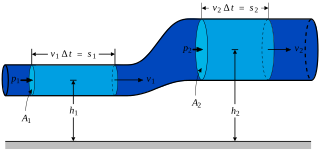
Water flows horizontally through a pipe that narrows from cross-section A₁ = 0.02 m² to A₂ = 0.005 m². The inlet speed is v₁ = 2 m/s and inlet pressure is P₁ = 200 000 Pa. Find the outlet pressure P₂. (ρ = 1000 kg/m³, horizontal so Δh = 0)
Solution
Step 1 — Use continuity to find v₂: A₁v₁ = A₂v₂ → v₂ = (0.02 × 2) / 0.005 = 8 m/s. Step 2 — Apply Bernoulli (same height): P₁ + ½ρv₁² = P₂ + ½ρv₂². Step 3 — Rearrange: P₂ = P₁ + ½ρ(v₁² − v₂²) = 200 000 + ½ × 1000 × (4 − 64) = 200 000 − 30 000.
Answer
P₂ = 170 000 Pa
Bernoulli's Equation — Assumptions and Real-World Applicability
| Assumption | Meaning | Breaks Down When | Example Application |
|---|---|---|---|
| Steady flow | Velocity at each point does not change with time | Pulsatile or transient flow | Pipe flow at constant pump speed |
| Incompressible | Density is constant | High-speed (Mach > 0.3) gas flow | Water in pipes |
| Inviscid | No internal friction | Viscous liquids, boundary layers | Ideal aerodynamics |
| Along a streamline | Energy conserved on one streamline | Cross-streamline analysis needed | Venturi meter |
| No work input | No pump or turbine along path | Pumped systems | Free jets, nozzles |
Interactive Tools
Wikimedia Commons, CC BY-SA
Related Terms
Fluid Pressure
Fluid pressure is the force exerted per unit area by a fluid on any surface in contact with it, arising from the continuous collisions of fluid molecules. In a static fluid, pressure at a given depth depends on the fluid's density, gravitational acceleration, and the depth below the free surface. It is fundamental to hydraulics, hydrostatics, and the design of dams, pipelines, and pressure vessels.
Laminar Flow
Laminar flow is a smooth, orderly regime of fluid motion in which fluid particles travel in parallel layers (laminae) without lateral mixing or cross-current fluctuations. It occurs at low Reynolds numbers (typically Re < 2300 in pipes) where viscous forces dominate over inertial forces, producing a parabolic velocity profile in pipe flow. Laminar flow is essential in microfluidics, blood flow in capillaries, lubrication engineering, and precision chemical dosing.
Reynolds Number
The Reynolds number (Re) is a dimensionless quantity that predicts the flow regime of a fluid by comparing inertial forces to viscous forces within the flow. A low Reynolds number indicates that viscous forces dominate, resulting in smooth laminar flow, while a high value signals that inertial forces dominate, leading to turbulent flow. It is indispensable in scaling model experiments to full-size systems, designing pipelines, and predicting aerodynamic behaviour around aircraft and vehicles.
Named after Swiss mathematician and physicist Daniel Bernoulli (1700–1782), who published the result in his treatise "Hydrodynamica" (1738). The term combines his surname with the Latin-derived "equation" (aequatio, a making equal).