
Cell Nucleus
The cell nucleus is a large, membrane-bound organelle found in eukaryotic cells that serves as the control center of the cell, housing the cell's genetic material (DNA) organized into chromosomes. It is surrounded by a double membrane called the nuclear envelope, which contains nuclear pores that regulate the transport of molecules between the nucleus and the cytoplasm. The nucleus directs cell activities by controlling gene expression, coordinating DNA replication during cell division, and producing ribosomal RNA in a specialized subregion called the nucleolus.
Components of the Cell Nucleus and Their Functions
| Component | Description | Function |
|---|---|---|
| Nuclear envelope | Double phospholipid membrane | Separates nucleus from cytoplasm; controls transport |
| Nuclear pores | Protein channels in nuclear envelope | Regulate import/export of molecules (RNA, proteins) |
| Chromatin | DNA wound around histone proteins | Stores genetic information; condenses into chromosomes during division |
| Nucleolus | Dense region within nucleus | Produces ribosomal RNA (rRNA); assembles ribosome subunits |
| Nucleoplasm | Fluid within nucleus | Suspends chromatin and nucleolus; site of transcription |
Interactive Tools
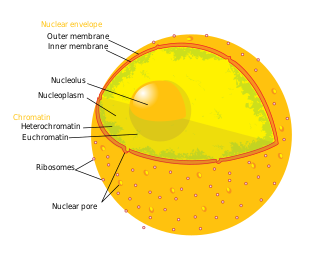
Wikimedia Commons, CC BY-SA
Related Terms
Eukaryote
A eukaryote is an organism whose cells contain a membrane-bound nucleus housing the DNA, along with other membrane-enclosed organelles such as mitochondria, endoplasmic reticulum, and the Golgi apparatus. Eukaryotes include all plants, animals, fungi, and protists, and their cells are generally much larger and more structurally complex than prokaryotic cells. The compartmentalization of cellular functions within organelles allows eukaryotes to perform more specialized and regulated biochemical processes.
Ribosome
Ribosomes are small, dense ribonucleoprotein complexes found in all living cells that carry out protein synthesis (translation) by decoding messenger RNA (mRNA) sequences into polypeptide chains. Each ribosome consists of two subunits — a large subunit and a small subunit — composed of ribosomal RNA (rRNA) and proteins, with prokaryotic ribosomes being 70S and eukaryotic cytoplasmic ribosomes being 80S. Ribosomes can be found free in the cytoplasm, where they synthesize cytosolic proteins, or bound to the rough endoplasmic reticulum, where they produce proteins destined for secretion or membrane insertion.
Endoplasmic Reticulum
The endoplasmic reticulum (ER) is an extensive network of interconnected membrane-bound tubules and flattened sacs (cisternae) that extends throughout the cytoplasm of eukaryotic cells and is continuous with the outer nuclear envelope. It exists in two forms: rough ER (RER), which is studded with ribosomes and specializes in the synthesis, folding, and quality control of proteins destined for secretion or membrane insertion; and smooth ER (SER), which lacks ribosomes and is involved in lipid synthesis, calcium storage, and detoxification of drugs and toxins. The ER works closely with the Golgi apparatus to process and sort proteins and lipids to their correct cellular destinations.
From Latin "nucleus" meaning kernel or inner part, itself derived from "nux" meaning nut. The term was applied to the cell's central body by Robert Brown in 1831 when he described it as a constant feature of plant cells, later recognized as universal in eukaryotes.