
Gradient Vector
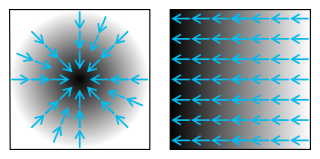
The gradient of a scalar function is a vector field whose components are the partial derivatives of the function with respect to each independent variable, pointing in the direction of the steepest rate of increase of the function. Denoted ∇f (nabla f), the gradient generalizes the ordinary derivative to multivariable functions. The gradient is fundamental in optimization (gradient descent), physics (conservative force fields), and machine learning for training neural networks.
Key Formula
∇f(x,y,z) = (∂f/∂x) î + (∂f/∂y) ĵ + (∂f/∂z) k̂
LaTeX: \nabla f(x,y,z) = \frac{\partial f}{\partial x}\,\hat{i} + \frac{\partial f}{\partial y}\,\hat{j} + \frac{\partial f}{\partial z}\,\hat{k}
| Symbol | Meaning | Unit |
|---|---|---|
| ∇f | Gradient vector of scalar function f | depends on f |
| ∂f/∂x | Partial derivative with respect to x (x-component) | per unit x |
| ∂f/∂y | Partial derivative with respect to y (y-component) | per unit y |
| ∂f/∂z | Partial derivative with respect to z (z-component) | per unit z |
| î, ĵ, k̂ | Unit vectors along x, y, z axes | dimensionless |
Worked Example
Problem
Find the gradient of f(x, y) = x²y + 3y² and evaluate it at the point (2, 1).
Solution
Step 1: Compute ∂f/∂x = 2xy. Step 2: Compute ∂f/∂y = x² + 6y. Step 3: Gradient vector: ∇f = (2xy) î + (x² + 6y) ĵ. Step 4: At (2, 1): ∇f = (2·2·1) î + (4 + 6) ĵ = 4î + 10ĵ.
Answer
∇f(2, 1) = (4, 10); magnitude = √(16 + 100) = √116 ≈ 10.77
Properties of the Gradient Vector
| Property | Statement | Geometric Meaning |
|---|---|---|
| Direction | ∇f points in direction of steepest ascent | Perpendicular to level curves |
| Magnitude | |∇f| = rate of steepest increase | Steeper surface → larger |∇f| |
| Zero gradient | ∇f = 0 at critical points | Local max, min, or saddle point |
| Directional derivative | D_u f = ∇f · û | Rate of change in direction û |
| Linearity | ∇(af + bg) = a∇f + b∇g | Superposition holds |
| Product rule | ∇(fg) = f∇g + g∇f | Analogous to Leibniz rule |
Interactive Tools
Wikimedia Commons, CC BY-SA
Related Terms
Partial Derivative
A partial derivative is the derivative of a multivariable function with respect to one variable while all other variables are held constant, measuring the function's instantaneous rate of change in a single coordinate direction. Denoted by the symbol ∂ (a stylized "d"), partial derivatives generalize single-variable differentiation to functions of two or more variables. They are essential in multivariable calculus, optimization, thermodynamics, fluid dynamics, and the formulation of partial differential equations.
Vector Divergence
Divergence is a scalar operator applied to a vector field that measures the net rate at which the vector field "spreads out" or "converges" at each point in space, representing the volumetric density of the outward flux of the field. A positive divergence indicates a source (field lines emanating outward), while negative divergence indicates a sink (field lines converging inward), and zero divergence means the field is incompressible. Divergence appears in Maxwell's equations for electromagnetism, the continuity equation in fluid mechanics, and Gauss's law.
Vector Curl
The curl of a vector field is a vector operator that describes the infinitesimal rotation or circulation of the field at each point in space, with its direction given by the axis of rotation (right-hand rule) and its magnitude equal to the rate of rotation. A zero curl means the field is irrotational (conservative), while non-zero curl indicates rotational behaviour. Curl appears in Faraday's law of electromagnetic induction, in the Navier-Stokes equations for fluid vorticity, and in defining conservative force fields in classical mechanics.
From Latin "gradus" (step, grade, degree of slope). The nabla symbol ∇ was introduced by William Rowan Hamilton in the 1850s and named "nabla" after the Hebrew harp of the same shape. The term "gradient" was established in vector calculus by Oliver Heaviside and Josiah Willard Gibbs in the late 19th century.