
Hooke's Law
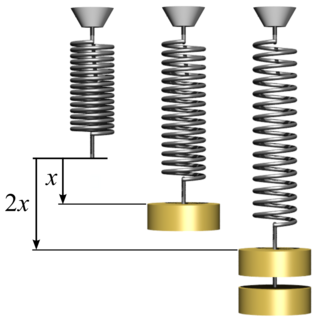
Hooke's Law states that, within the elastic limit of a material, the deformation (extension or compression) of a spring or elastic solid is directly proportional to the applied force. It was formulated by English scientist Robert Hooke in 1676 and is expressed as F = kx, where k is the spring constant characterising the stiffness of the material. Hooke's Law underpins the design of force gauges, seismometers, automotive suspensions, and the theory of elasticity in materials science.
Key Formula
F = k × x
LaTeX: F = kx
| Symbol | Meaning | Unit |
|---|---|---|
| F | Applied force causing deformation | N (Newton) |
| k | Spring constant (stiffness coefficient) | N/m |
| x | Extension or compression from natural length | m |
Worked Example
Problem
A spring obeys Hooke's Law. When a 4 N force is applied, the spring extends by 8 cm. (a) Find the spring constant k. (b) What extension would a 10 N force produce?
Solution
Part (a): Rearrange F = kx → k = F / x = 4 / 0.08 = 50 N/m. Part (b): x = F / k = 10 / 50 = 0.20 m = 20 cm.
Answer
(a) k = 50 N/m. (b) Extension = 20 cm.
Hooke's Law: force vs. extension for a spring with k = 50 N/m
| Applied Force F (N) | Extension x (cm) | Within Elastic Limit? | Elastic PE Stored (J) |
|---|---|---|---|
| 0 | 0 | Yes | 0.000 |
| 2 | 4 | Yes | 0.040 |
| 4 | 8 | Yes | 0.160 |
| 6 | 12 | Yes | 0.360 |
| 8 | 16 | Yes | 0.640 |
| 15 | 35 (non-linear) | No — past elastic limit | — |
Interactive Tools
Wikimedia Commons, CC BY-SA
Related Terms
Spring Force
Spring force is the restoring force exerted by a compressed or stretched elastic spring, always directed back toward the spring's natural (equilibrium) length. It is a specific application of Hooke's Law and is proportional to the displacement from equilibrium. Spring forces are fundamental to mechanical oscillators, shock absorbers, force sensors, and the microscopic bonding forces between atoms.
Elastic Potential Energy
Elastic potential energy is the energy stored in a deformed elastic object — such as a stretched spring, a compressed rubber band, or a bent bow — that can be fully recovered when the deforming force is removed. It arises from the intermolecular forces within the elastic material that resist deformation and is equal to the work done in stretching or compressing the object. Elastic PE is pivotal in springs, archery, vehicle suspensions, and the molecular-scale understanding of elasticity.
Named after Robert Hooke (1635–1703), English polymath and contemporary of Isaac Newton. Hooke first stated the law in 1676 as an anagram — "ceiiinosssttuv" — decoded in 1678 as "Ut tensio, sic vis" (Latin: "As the extension, so the force"). Hooke published it in full in his work "De Potentia Restitutiva".