
Integral
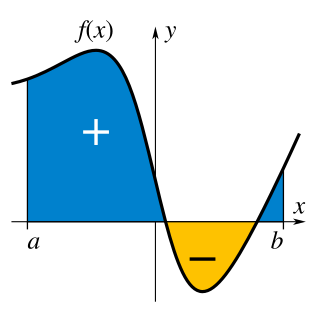
An integral is a mathematical object that represents the accumulation of quantities, such as areas under curves, total displacement, or accumulated change. There are two main types: the definite integral, which yields a numerical value representing the net area between a function and the x-axis over an interval, and the indefinite integral, which yields a family of antiderivative functions. Integration is the reverse process of differentiation and is one of the two fundamental operations of calculus.
Key Formula
∫ f(x) dx = F(x) + C
LaTeX: \int f(x)\, dx = F(x) + C
| Symbol | Meaning | Unit |
|---|---|---|
| f(x) | Integrand (function being integrated) | dimensionless |
| F(x) | Antiderivative of f(x) | dimensionless |
| C | Constant of integration | dimensionless |
| dx | Differential variable of integration | dimensionless |
Worked Example
Problem
Find the integral of f(x) = 3x² + 2x.
Solution
Step 1: Apply the power rule for integration: ∫xⁿ dx = xⁿ⁺¹/(n+1) + C. Step 2: Integrate term by term: ∫3x² dx = 3 · x³/3 = x³. ∫2x dx = 2 · x²/2 = x². Step 3: Add the constant of integration C.
Answer
∫(3x² + 2x) dx = x³ + x² + C
Common Integration Rules
| Rule Name | Formula | Example | Result | Note |
|---|---|---|---|---|
| Power Rule | ∫xⁿ dx = xⁿ⁺¹/(n+1) + C | ∫x³ dx | x⁴/4 + C | n ≠ −1 |
| Constant Rule | ∫k dx = kx + C | ∫5 dx | 5x + C | k is constant |
| Sum Rule | ∫(f+g) dx = ∫f dx + ∫g dx | ∫(x²+1) dx | x³/3 + x + C | Linearity |
| Exponential | ∫eˣ dx = eˣ + C | ∫e²ˣ dx | e²ˣ/2 + C | Chain rule applies |
| Natural Log | ∫1/x dx = ln|x| + C | ∫1/x dx | ln|x| + C | n = −1 case |
Interactive Tools
Wikimedia Commons, CC BY-SA
Related Terms
Definite Integral
A definite integral is an integral evaluated over a specific closed interval [a, b], producing a single numerical value that represents the net signed area between the function's curve and the x-axis over that interval. It is defined as the limit of Riemann sums as the number of subintervals approaches infinity. Definite integrals are used extensively in physics for calculating work, displacement, charge, and probability.
Indefinite Integral
An indefinite integral is the general antiderivative of a function, representing a family of functions that differ only by a constant. Unlike the definite integral, it produces a function rather than a number, and includes an arbitrary constant of integration C that accounts for all possible antiderivatives. Indefinite integrals are the starting point for solving differential equations and computing definite integrals via the Fundamental Theorem of Calculus.
Fundamental Theorem of Calculus
The Fundamental Theorem of Calculus establishes the deep connection between differentiation and integration, showing that they are inverse operations. It has two parts: the first part states that if F is the integral function of f, then F is differentiable and F'(x) = f(x); the second part provides a practical method for evaluating definite integrals using antiderivatives. This theorem is arguably the most important result in calculus, unifying two independently developed concepts by Newton and Leibniz.
From Latin "integralis" meaning "making whole" or "entire." Leibniz introduced the elongated S symbol ∫ (from Latin "summa" meaning sum) in 1675 to denote integration as an infinite summation process.