
Ionic Bond
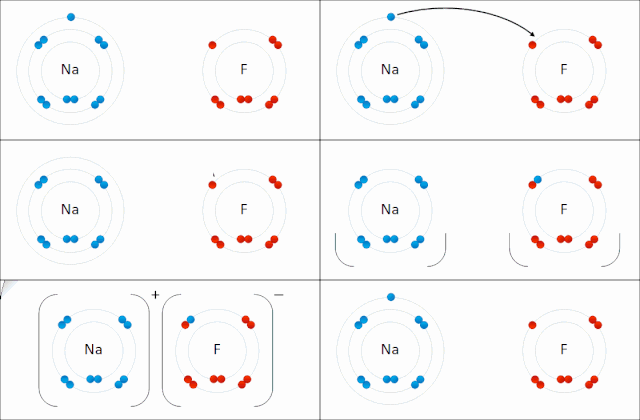
An ionic bond is a type of chemical bond formed through the complete transfer of one or more electrons from a metal atom to a non-metal atom, creating oppositely charged ions that attract each other electrostatically. This electrostatic attraction between cations (positively charged) and anions (negatively charged) holds the compound together in a crystal lattice structure. Ionic bonds are responsible for the properties of salts such as high melting points, brittleness, and electrical conductivity when dissolved in water.
Worked Example
Problem
Sodium (Na) reacts with chlorine (Cl) to form sodium chloride (NaCl). How many electrons are transferred, and what ions are formed?
Solution
Step 1: Identify electron configurations. Na has 1 valence electron (2,8,1) and Cl has 7 valence electrons (2,8,7). Step 2: Na loses 1 electron to achieve a stable noble gas configuration (2,8), forming Na⁺ (sodium cation). Step 3: Cl gains 1 electron to achieve a stable noble gas configuration (2,8,8), forming Cl⁻ (chloride anion). Step 4: The electrostatic attraction between Na⁺ and Cl⁻ forms the ionic bond in NaCl.
Answer
1 electron is transferred; Na⁺ and Cl⁻ ions are formed, held together by electrostatic attraction.
Properties of Common Ionic Compounds
| Compound | Formula | Melting Point (°C) | Solubility in Water | Conductivity (molten) |
|---|---|---|---|---|
| Sodium Chloride | NaCl | 801 | Soluble | Yes |
| Potassium Iodide | KI | 681 | Soluble | Yes |
| Calcium Fluoride | CaF₂ | 1418 | Insoluble | Yes |
| Magnesium Oxide | MgO | 2852 | Slightly soluble | Yes |
| Lithium Bromide | LiBr | 552 | Soluble | Yes |
Interactive Tools
Wikimedia Commons, CC BY-SA
Related Terms
Covalent Bond
A covalent bond is a type of chemical bond formed when two atoms share one or more pairs of electrons, resulting in a stable arrangement for both atoms. This sharing occurs most commonly between non-metal atoms that have similar electronegativities, allowing each atom to achieve a full valence shell without complete electron transfer. Covalent bonds are the foundation of organic chemistry and molecular biology, governing the structure of molecules ranging from water (H₂O) to complex proteins.
Electronegativity
Electronegativity is a measure of the tendency of an atom to attract a shared pair of electrons toward itself within a covalent bond, expressed on a dimensionless scale. The most widely used scale is the Pauling scale, where fluorine is assigned the highest value of 3.98, making it the most electronegative element, and caesium the lowest at 0.79. Electronegativity determines bond polarity, the character of chemical bonds (ionic vs. covalent), and influences molecular properties such as reactivity, acid strength, and solubility.
Lewis Structure
A Lewis structure (also called a Lewis dot structure or electron dot diagram) is a two-dimensional representation of a molecule that shows the arrangement of atoms, bonding electron pairs (as lines or pairs of dots between atoms), and lone (non-bonding) electron pairs. Developed by Gilbert N. Lewis in 1916, these diagrams are essential tools for predicting molecular geometry, reactivity, and understanding bond types. Lewis structures obey the octet rule — most atoms in a molecule strive to have 8 electrons in their valence shell, with the notable exception of hydrogen (which requires only 2).
From Greek "ion" (going), coined by Michael Faraday in 1834 to describe particles that migrate toward electrodes. The term "ionic bond" entered chemistry in the early 20th century as atomic theory developed.