
Kepler's First Law
Kepler's First Law, also called the Law of Ellipses, states that every planet orbits the Sun in an elliptical path, with the Sun located at one of the two foci of the ellipse (not at the centre). This was a revolutionary departure from the previous belief in perfectly circular orbits. The degree of elongation of the ellipse is described by its eccentricity (e), where e = 0 is a circle and e approaching 1 is a highly elongated ellipse.
Key Formula
e = c/a = √(1 − b²/a²)
LaTeX: e = \frac{c}{a} = \sqrt{1 - \frac{b^2}{a^2}}
| Symbol | Meaning | Unit |
|---|---|---|
| e | Eccentricity of the ellipse | Dimensionless (0 to 1) |
| c | Distance from centre to focus | AU or m |
| a | Semi-major axis (longest radius) | AU or m |
| b | Semi-minor axis (shortest radius) | AU or m |
Worked Example
Problem
An asteroid has a semi-major axis a = 3.0 AU and a semi-minor axis b = 2.4 AU. Calculate the eccentricity of its orbit and the distance from the centre to the focus.
Solution
Step 1: Use e = √(1 − b²/a²) Step 2: e = √(1 − (2.4)²/(3.0)²) Step 3: e = √(1 − 5.76/9.00) Step 4: e = √(1 − 0.64) Step 5: e = √0.36 = 0.6 Step 6: Distance to focus: c = e × a = 0.6 × 3.0 = 1.8 AU
Answer
Eccentricity e = 0.6; distance from centre to focus c = 1.8 AU
Orbital Eccentricities of Solar System Bodies
| Body | Semi-major Axis (AU) | Eccentricity | Orbit Shape |
|---|---|---|---|
| Venus | 0.723 | 0.007 | Nearly circular |
| Earth | 1.000 | 0.017 | Near circular |
| Mars | 1.524 | 0.093 | Slightly elliptical |
| Mercury | 0.387 | 0.206 | Noticeably elliptical |
| Pluto | 39.48 | 0.249 | Clearly elliptical |
| Halley's Comet | 17.8 | 0.967 | Highly elongated |
Interactive Tools
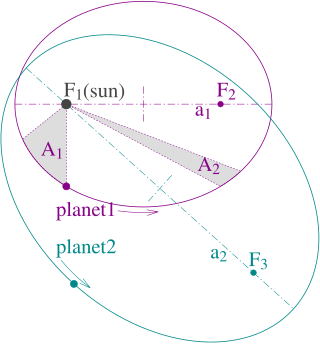
Wikimedia Commons, CC BY-SA
Related Terms
Planetary Orbit
A planetary orbit is the curved path followed by a planet as it moves around the Sun (or another star) under the influence of gravitational attraction. According to Kepler's First Law, planetary orbits are ellipses with the Sun at one of the two foci. The shape of an orbit is described by its eccentricity, where 0 represents a perfect circle and values approaching 1 represent highly elongated ellipses.
Kepler's Second Law
Kepler's Second Law, also called the Law of Equal Areas, states that a line segment joining a planet to the Sun sweeps out equal areas in equal intervals of time. This means a planet moves faster when it is closer to the Sun (at perihelion) and slower when it is farther away (at aphelion). This law is a consequence of the conservation of angular momentum and applies to any body moving under the influence of a central gravitational force.
The Sun
The Sun is the star at the centre of the Solar System, a nearly perfect sphere of hot plasma that generates energy through nuclear fusion of hydrogen into helium in its core. It accounts for about 99.86% of the total mass of the Solar System and provides the light and heat essential for life on Earth. The Sun is classified as a G-type main-sequence star (G2V) with a surface temperature of approximately 5,778 K and a diameter of about 1.39 million kilometres.
Named after German mathematician and astronomer Johannes Kepler (1571–1630), who published this law in his work "Astronomia Nova" (New Astronomy) in 1609. The term "law of ellipses" emerged as a descriptive label used by later astronomers and educators.