
Kepler's Third Law
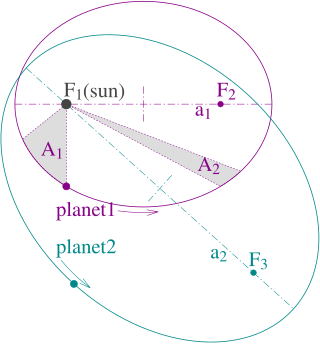
Kepler's Third Law states that the square of the orbital period of a planet is proportional to the cube of the semi-major axis of its orbit around the Sun. This relationship, discovered by Johannes Kepler in 1619, applies to all objects orbiting the same central body and allows astronomers to calculate orbital periods or distances when one is known. It was later explained theoretically by Newton's law of universal gravitation and remains a foundational tool for planetary science and space mission planning.
Key Formula
T^2 = (4π² / GM) × a³
LaTeX: T^2 = \frac{4\pi^2}{GM} a^3
| Symbol | Meaning | Unit |
|---|---|---|
| T | Orbital period | seconds (s) |
| a | Semi-major axis of orbit | metres (m) |
| G | Universal gravitational constant | N·m²·kg⁻² |
| M | Mass of the central body | kilograms (kg) |
Worked Example
Problem
Mars orbits the Sun with a semi-major axis of 1.524 AU. Using Kepler's Third Law, calculate its orbital period in Earth years.
Solution
Step 1: Apply the simplified form T² = a³ (where T is in Earth years and a is in AU). Step 2: T² = (1.524)³ = 3.540 AU³. Step 3: T = √3.540 = 1.881 Earth years.
Answer
T ≈ 1.88 Earth years (approximately 687 Earth days), which matches the known Martian year.
Orbital periods and semi-major axes of Solar System planets (Kepler's Third Law verification)
| Planet | Semi-major Axis (AU) | Orbital Period (years) | a³ | T² |
|---|---|---|---|---|
| Mercury | 0.387 | 0.241 | 0.0580 | 0.0581 |
| Earth | 1.000 | 1.000 | 1.000 | 1.000 |
| Mars | 1.524 | 1.881 | 3.540 | 3.538 |
| Jupiter | 5.203 | 11.86 | 140.9 | 140.7 |
| Saturn | 9.537 | 29.46 | 866.4 | 867.9 |
Interactive Tools
Wikimedia Commons, CC BY-SA
Related Terms
Gravitational Force (Astronomy)
Gravitational force in astronomy is the attractive force between any two masses, governed by Newton's Law of Universal Gravitation, which states that the force is proportional to the product of the masses and inversely proportional to the square of the distance between them. This force is responsible for holding planets in orbit around the Sun, governing the motion of moons, shaping the structure of galaxies, and dictating the trajectories of spacecraft. It is the dominant long-range force at astronomical scales and underlies phenomena from tidal locking to the formation of planetary systems.
Orbital Mechanics
Orbital mechanics (also called astrodynamics) is the branch of aerospace engineering and applied physics that studies the motion of spacecraft, satellites, and celestial bodies under the influence of gravitational forces. It is governed by Newton's law of universal gravitation and Kepler's three laws of planetary motion, and it underpins the planning of satellite launches, orbital transfers, interplanetary trajectories, and re-entry profiles. Mastery of orbital mechanics is essential for mission design, ground-track prediction, and spacecraft manoeuvring.
Named after German astronomer Johannes Kepler (1571–1630), who published this law in his 1619 work Harmonices Mundi (Harmony of the Worlds). The word "law" derives from Old English lagu, meaning "something laid down or fixed."