
Magnetic Field
A magnetic field is a vector field that describes the magnetic influence on moving electric charges, electric currents, and magnetic materials, exerting a force on them perpendicular to their velocity. It is represented by the magnetic flux density B (measured in tesla) and arises from electric currents, changing electric fields, and intrinsic magnetic moments of elementary particles. Magnetic fields are central to the operation of motors, generators, MRI machines, and data storage devices.
Key Formula
F = q × v × B × sin(theta)
LaTeX: F = qvB\sin\theta
| Symbol | Meaning | Unit |
|---|---|---|
| F | Magnetic force on the charge | Newton (N) |
| q | Electric charge of the particle | Coulomb (C) |
| v | Speed of the particle | Metre per second (m/s) |
| B | Magnetic flux density | Tesla (T) |
| θ | Angle between velocity and magnetic field | Degree or Radian |
Worked Example
Problem
An electron (charge = 1.6 × 10⁻¹⁹ C) moves at 3 × 10⁶ m/s perpendicular to a magnetic field of 0.5 T. Find the magnetic force on the electron.
Solution
Step 1: θ = 90° so sin(90°) = 1. Step 2: F = qvB sin θ = 1.6 × 10⁻¹⁹ × 3 × 10⁶ × 0.5 × 1. Step 3: F = 1.6 × 10⁻¹⁹ × 1.5 × 10⁶ = 2.4 × 10⁻¹³ N.
Answer
F = 2.4 × 10⁻¹³ N
Typical Magnetic Field Strengths in Nature and Technology
| Source | Magnetic Field (T) | Order of Magnitude | Notes |
|---|---|---|---|
| Earth's surface | 2.5–6.5 × 10⁻⁵ | 10⁻⁵ T | Varies by location |
| Refrigerator magnet | ~0.005 | 10⁻³ T | Permanent magnet |
| MRI machine (clinical) | 1.5 – 3 | 1 T | Medical imaging |
| Loudspeaker magnet | ~1 | 1 T | Audio device |
| Strongest continuous lab magnet | ~45 | 10¹ T | NHMFL, USA |
| Neutron star surface | 10⁸ – 10¹¹ | 10⁹ T | Magnetar |
Interactive Tools
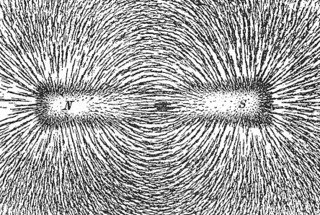
Wikimedia Commons, CC BY-SA
Related Terms
Inductor
An inductor is a passive electrical component, typically a coil of wire, that stores energy in a magnetic field when current flows through it and opposes changes in current through electromagnetic induction. Its inductance (measured in henries) quantifies the ratio of the magnetic flux linkage to the current. Inductors are essential in filters, oscillators, transformers, and switching power supplies.
Transformer (electrical)
An electrical transformer is a static electromagnetic device that transfers electrical energy between two or more circuits through electromagnetic induction, typically changing the voltage and current levels while keeping frequency and power (ideally) constant. It consists of a primary coil and one or more secondary coils wound around a shared iron core. Transformers are indispensable in power transmission, allowing high-voltage transmission over long distances to reduce resistive losses.
Electric Current
Electric current is the rate of flow of electric charge through a conductor, measured as the amount of charge passing a cross-section per unit time. It is the fundamental quantity that drives electrical circuits and powers all electronic devices. In metallic conductors, current arises from the drift of free electrons, while in electrolytes and plasma it involves the movement of ions.
From Greek "magnetis lithos" meaning "Magnesian stone", referring to loadstone found near the ancient city of Magnesia in modern-day Turkey. The systematic study of magnetic fields was formalised by Michael Faraday in the 1840s, who introduced the concept of field lines, and mathematically unified by James Clerk Maxwell in 1865.