
Membrane Potential
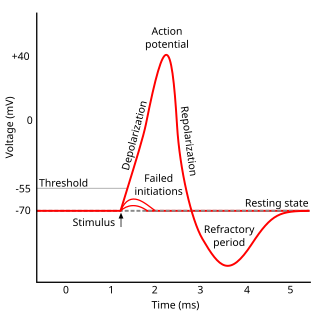
Membrane potential is the electric potential difference across a cell's plasma membrane, arising from the unequal distribution of ions (Na⁺, K⁺, Cl⁻, Ca²⁺) between the intracellular and extracellular environments. In neurons and muscle cells, the resting membrane potential is approximately −70 mV (inside negative), maintained by the Na⁺/K⁺-ATPase pump and selective ion channels. Changes in membrane potential — action potentials — underlie nerve impulse transmission and muscle contraction.
Key Formula
E_m = (RT / zF) × ln([X]_outside / [X]_inside)
LaTeX: E_m = \frac{RT}{zF} \ln\frac{[X]_o}{[X]_i}
| Symbol | Meaning | Unit |
|---|---|---|
| E_m | Equilibrium (Nernst) potential for ion X | mV |
| R | Universal gas constant | J mol⁻¹ K⁻¹ |
| T | Absolute temperature | K |
| z | Valence (charge) of the ion | dimensionless |
| F | Faraday's constant (96485) | C mol⁻¹ |
| [X]_o | Extracellular ion concentration | mM |
| [X]_i | Intracellular ion concentration | mM |
Worked Example
Problem
Calculate the equilibrium potential for K⁺ at 37 °C. Given: [K⁺]_outside = 5 mM, [K⁺]_inside = 140 mM, z = +1.
Solution
Step 1: Convert temperature: T = 37 + 273.15 = 310.15 K. Step 2: Compute RT/zF: (8.314 × 310.15) / (1 × 96485) = 2578.0 / 96485 ≈ 0.02671 V. Step 3: Compute ln([K⁺]_o / [K⁺]_i) = ln(5 / 140) = ln(0.03571) ≈ −3.332. Step 4: E_K = 0.02671 × (−3.332) ≈ −0.08899 V = −89 mV.
Answer
E_K ≈ −89 mV
Typical Ion Concentrations and Equilibrium Potentials in a Mammalian Neuron
| Ion | Intracellular (mM) | Extracellular (mM) | Equilibrium Potential (mV) |
|---|---|---|---|
| K⁺ | 140 | 5 | −89 |
| Na⁺ | 12 | 145 | +67 |
| Cl⁻ | 4 | 120 | −86 |
| Ca²⁺ | 0.0001 | 1.5 | +122 |
Interactive Tools
Wikimedia Commons, CC BY-SA
Related Terms
Cell Signaling
Cell signaling refers to the complex system of communication by which cells detect, process, and respond to chemical signals from their environment or neighbouring cells. Signaling pathways typically involve a ligand binding to a receptor, triggering an intracellular cascade of molecular events that alter gene expression, metabolism, or cell behaviour. It governs fundamental processes such as growth, differentiation, immune responses, and apoptosis.
Apoptosis
Apoptosis is a form of programmed, genetically regulated cell death that occurs in multicellular organisms as a normal and controlled part of development and homeostasis. It is characterised by cell shrinkage, chromatin condensation, membrane blebbing, and fragmentation into apoptotic bodies that are cleared by phagocytes without triggering inflammation. Dysregulation of apoptosis is implicated in cancer (insufficient apoptosis) and neurodegenerative diseases (excessive apoptosis).
Stem Cell
A stem cell is an undifferentiated cell capable of self-renewal and differentiation into specialised cell types. Stem cells are found in embryos (embryonic stem cells) and adult tissues (adult stem cells), serving as a repair and replenishment system throughout life. Their unique plasticity makes them central to regenerative medicine, disease modelling, and therapeutic research.
From Latin "membrana" (thin skin) + Latin "potentia" (power, ability). The concept was quantified by Walther Nernst in the 1880s and expanded by Goldman, Hodgkin, and Katz with the GHK equation in 1943.