
Nuclear Binding Energy
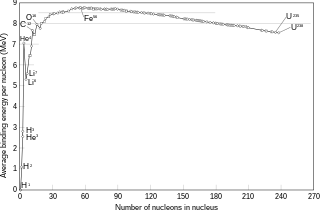
Nuclear binding energy is the energy required to completely separate a nucleus into its individual protons and neutrons, or equivalently, the energy released when these nucleons combine to form the nucleus. It arises from the strong nuclear force overcoming electromagnetic repulsion between protons, and is directly related to the mass defect — the difference between the mass of the nucleus and the sum of masses of its constituent nucleons via Einstein's E = mc². The binding energy per nucleon peaks around iron-56, explaining why both fusion of light nuclei and fission of heavy nuclei can release energy.
Key Formula
E_b = Δm × c² = [Z × m_p + N × m_n − m_nucleus] × c²
LaTeX: E_b = \Delta m \cdot c^2 = \left[Z m_p + N m_n - m_{\text{nucleus}}\right] c^2
| Symbol | Meaning | Unit |
|---|---|---|
| E_b | Nuclear binding energy | J (or MeV) |
| Δm | Mass defect | kg (or u) |
| Z | Number of protons | dimensionless |
| N | Number of neutrons | dimensionless |
| m_p | Proton mass (1.6726 × 10⁻²⁷ kg) | kg |
| m_n | Neutron mass (1.6749 × 10⁻²⁷ kg) | kg |
| c | Speed of light (3 × 10⁸ m/s) | m/s |
Worked Example
Problem
Calculate the binding energy of helium-4 (⁴He). Given: m(⁴He nucleus) = 4.00150 u, m_p = 1.00728 u, m_n = 1.00867 u. (1 u = 931.5 MeV/c²)
Solution
Step 1: Helium-4 has Z = 2 protons and N = 2 neutrons. Step 2: Sum of constituent masses = 2(1.00728) + 2(1.00867) = 2.01456 + 2.01734 = 4.03190 u. Step 3: Mass defect: Δm = 4.03190 − 4.00150 = 0.03040 u. Step 4: Binding energy: E_b = 0.03040 u × 931.5 MeV/u = 28.32 MeV. Step 5: Binding energy per nucleon = 28.32 / 4 = 7.08 MeV/nucleon.
Answer
E_b ≈ 28.3 MeV; Binding energy per nucleon ≈ 7.08 MeV/nucleon
Binding Energy Per Nucleon for Selected Nuclides
| Nuclide | Z | A | Total Binding Energy (MeV) | Binding Energy/Nucleon (MeV) |
|---|---|---|---|---|
| Helium-4 | 2 | 4 | 28.30 | 7.07 |
| Carbon-12 | 6 | 12 | 92.16 | 7.68 |
| Iron-56 | 26 | 56 | 492.26 | 8.79 |
| Uranium-235 | 92 | 235 | 1783.89 | 7.59 |
| Uranium-238 | 92 | 238 | 1801.69 | 7.57 |
Interactive Tools
Wikimedia Commons, CC BY-SA
Related Terms
Strong Nuclear Force
The strong nuclear force is the most powerful of the four fundamental forces of nature, responsible for binding quarks together to form protons and neutrons (via the colour force mediated by gluons) and for holding protons and neutrons together within an atomic nucleus (via the residual strong force mediated by pions). It operates only at extremely short range (about 10⁻¹⁵ m, or 1 femtometre), is approximately 137 times stronger than electromagnetism at nuclear distances, and is charge-independent — it acts equally between proton-proton, proton-neutron, and neutron-neutron pairs. Without the strong force, atomic nuclei would be instantly torn apart by electrostatic repulsion between protons.
Radioactive Decay
Radioactive decay is the spontaneous transformation of an unstable atomic nucleus into a more stable configuration by emitting radiation in the form of particles or electromagnetic waves. This process occurs because the nucleus has too many protons, too many neutrons, or excess energy, making it thermodynamically unstable. It is the foundation of nuclear medicine, radiometric dating, and nuclear power generation.
Half-Life
Half-life (t₁/₂) is the time required for exactly half of the radioactive atoms in a sample to undergo decay, reducing the number of undecayed nuclei to 50% of the original count. It is a constant property of each radioactive isotope, independent of temperature, pressure, or chemical state, ranging from microseconds for highly unstable nuclei to billions of years for stable isotopes. Half-life is essential in radiometric dating, nuclear medicine dosage, and radioactive waste management.
The concept of "binding energy" was developed in the 1930s following Einstein's mass-energy equivalence (1905) and James Chadwick's discovery of the neutron (1932). The term reflects the energy needed to "unbind" or separate the nuclear constituents.