
Operational Amplifier
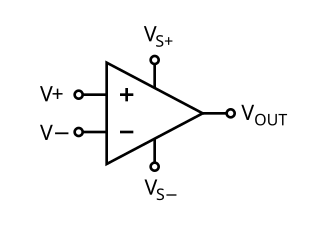
An operational amplifier (op-amp) is a high-gain, direct-coupled differential amplifier with very high input impedance and very low output impedance, designed to perform mathematical operations such as addition, subtraction, integration, and differentiation on electrical signals. The ideal op-amp has infinite open-loop gain, infinite input impedance, zero output impedance, and infinite bandwidth. Op-amps are fundamental building blocks in analogue electronics, used in signal conditioning, filters, oscillators, comparators, and instrumentation.
Key Formula
V_out = A_OL × (V+ − V−), where A_OL is open-loop gain
LaTeX: V_{out} = A_{OL}(V_+ - V_-)
| Symbol | Meaning | Unit |
|---|---|---|
| V_{out} | Output voltage | Volt (V) |
| A_{OL} | Open-loop voltage gain (typically 10⁵ to 10⁶) | dimensionless (V/V) |
| V_+ | Non-inverting input voltage | Volt (V) |
| V_- | Inverting input voltage | Volt (V) |
Worked Example
Problem
An inverting amplifier uses an op-amp with R₁ = 10 kΩ (input resistor) and R_f = 100 kΩ (feedback resistor). If V_in = 0.5 V, find V_out.
Solution
Step 1: Inverting amplifier gain formula: A_v = −R_f / R₁. Step 2: A_v = −100,000 / 10,000 = −10. Step 3: V_out = A_v × V_in = −10 × 0.5 = −5 V. Step 4: Negative sign indicates 180° phase inversion.
Answer
V_out = −5 V (inverted and amplified 10×)
Common Op-Amp Configurations and Their Gain Formulas
| Configuration | Gain Formula | Input Impedance | Typical Use |
|---|---|---|---|
| Inverting amplifier | A_v = −R_f / R_in | R_in | Signal inversion and scaling |
| Non-inverting amplifier | A_v = 1 + R_f / R₁ | Very high (≈ ∞) | Buffer and voltage gain |
| Voltage follower (buffer) | A_v = 1 | Very high (≈ ∞) | Impedance isolation |
| Summing amplifier | V_out = −R_f(V₁/R₁ + V₂/R₂) | R₁, R₂ independently | Audio mixing, DAC |
| Differentiator | V_out = −R_f C dV_in/dt | Capacitive | Edge detection |
| Integrator | V_out = −(1/RC) ∫V_in dt | R_in | Waveform shaping |
Interactive Tools
Wikimedia Commons, CC BY-SA
Related Terms
Transistor
A transistor is a semiconductor device with three terminals that can amplify electrical signals or act as an electronic switch by controlling current flow between two terminals using a small input signal at the third. The two main types are the Bipolar Junction Transistor (BJT), which is current-controlled, and the Metal-Oxide-Semiconductor Field-Effect Transistor (MOSFET), which is voltage-controlled. Transistors are the fundamental building blocks of modern electronics, with billions packed into a single integrated circuit chip.
Thevenin's Theorem
Thevenin's Theorem states that any linear electrical network with voltage sources, current sources, and resistances can be replaced by an equivalent circuit consisting of a single voltage source (V_th) in series with a single resistance (R_th). This simplification makes it much easier to analyse the behaviour of a load connected to a complex network, as only the terminal behaviour matters. It is widely used in circuit design, power systems, and electronics to simplify analysis without solving the full network repeatedly.
Boolean Algebra
Boolean algebra is a branch of algebra in which the variables can only take the values 0 (false) or 1 (true), and the operations are AND (conjunction, ·), OR (disjunction, +), and NOT (negation, ‾). It provides the mathematical framework for analysing and simplifying digital logic circuits, and is the theoretical foundation of computer science and digital electronics. Boolean expressions can be simplified using theorems and laws such as De Morgan's Theorems, the absorption law, and consensus theorem to reduce the number of logic gates required in a circuit.
The term "operational amplifier" was coined by John R. Ragazzini in a 1947 paper describing amplifiers used in analogue computers to perform mathematical operations. "Operational" comes from Latin "operationalis", relating to an operation or work. The first monolithic IC op-amp (μA709) was introduced by Fairchild Semiconductor in 1965.