
Permutation
A permutation is an arrangement of all or part of a set of objects in a specific order, where the order of selection matters. The number of permutations of r objects chosen from n distinct objects is denoted P(n, r) or nPr. Permutations are central to combinatorics, probability theory, and appear in computing contexts such as sorting algorithms and cryptography.
Key Formula
P(n, r) = n! / (n − r)!
LaTeX: P(n, r) = \frac{n!}{(n - r)!}
| Symbol | Meaning | Unit |
|---|---|---|
| n | Total number of distinct objects | count |
| r | Number of objects selected | count |
| n! | n factorial = n × (n−1) × … × 1 | dimensionless |
| P(n,r) | Number of ordered arrangements | count |
Worked Example
Problem
In a race with 8 runners, in how many ways can the gold, silver, and bronze medals be awarded (all to different runners)?
Solution
Step 1: Identify n and r. — n = 8 (total runners), r = 3 (medals to assign) Step 2: Apply the permutation formula. — P(8, 3) = 8! / (8 − 3)! = 8! / 5! Step 3: Expand. — 8! = 40320, 5! = 120 — P(8, 3) = 40320 / 120 = 336 Alternatively: 8 × 7 × 6 = 336.
Answer
There are 336 ways to award the three medals from 8 runners.
Permutation Values P(n, r) for Small n and r
| n \ r | r = 1 | r = 2 | r = 3 | r = n (all) |
|---|---|---|---|---|
| n = 3 | 3 | 6 | 6 | 6 |
| n = 4 | 4 | 12 | 24 | 24 |
| n = 5 | 5 | 20 | 60 | 120 |
| n = 6 | 6 | 30 | 120 | 720 |
| n = 8 | 8 | 56 | 336 | 40320 |
Interactive Tools
Brilliant — Combinatorics
Comprehensive combinatorics course covering permutations and combinations.
Open Tool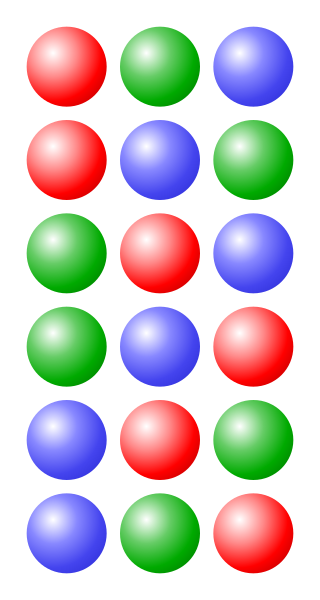
Wikimedia Commons, CC BY-SA
Related Terms
Combination
A combination is a selection of objects from a set where the order of selection does not matter. The number of ways to choose r objects from n distinct objects is denoted C(n, r), nCr, or the binomial coefficient "n choose r". Combinations are used extensively in probability, statistics, the binomial theorem, and in applications such as lottery analysis, team selection, and clinical trial design.
Bijection
A bijection (or bijective function) is a function that is both injective (one-to-one) and surjective (onto), meaning every element of the domain maps to a unique element of the codomain, and every element of the codomain is mapped to by exactly one element of the domain. Bijections establish a perfect one-to-one correspondence between two sets and are fundamental in defining cardinality, invertible functions, and isomorphisms across mathematics.
Set Theory
Set theory is the branch of mathematical logic that studies collections of objects, called sets, and the relationships between them. It provides the foundational language for nearly all of modern mathematics, defining concepts like numbers, functions, and relations in terms of sets. Developed formally by Georg Cantor in the 1870s, it underpins areas from algebra and topology to computer science and logic.
From Latin "permutatio" (a thorough change), from "per" (thoroughly) + "mutare" (to change). The mathematical study of permutations was formalised by Gottfried Leibniz and later by Augustin-Louis Cauchy in the 19th century.