
Plate Tectonics
Plate tectonics is the scientific theory describing how Earth's lithosphere is divided into large, rigid segments called tectonic plates that move over the underlying asthenosphere. These plates interact at their boundaries through convergence, divergence, or lateral sliding, driving processes such as mountain building, ocean floor spreading, and volcanic activity. The theory unifies many geological phenomena and explains the distribution of earthquakes, volcanoes, and major landforms across Earth's surface.
Types of Tectonic Plate Boundaries
| Boundary Type | Plate Motion | Resulting Feature | Example |
|---|---|---|---|
| Convergent | Plates move toward each other | Mountain ranges, trenches | Himalayas (India–Eurasia) |
| Divergent | Plates move apart | Mid-ocean ridges, rift valleys | Mid-Atlantic Ridge |
| Transform | Plates slide past each other | Strike-slip faults | San Andreas Fault, USA |
| Subduction Zone | Denser plate sinks below lighter | Deep-sea trenches, volcanoes | Japan Trench |
| Collision Zone | Two continental plates converge | High mountain belts | Alps (Africa–Europe) |
Interactive Tools
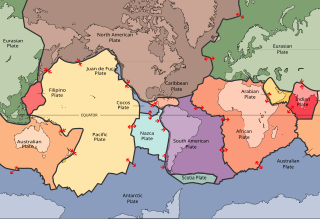
Wikimedia Commons, CC BY-SA
Related Terms
Continental Drift
Continental drift is the hypothesis that Earth's continents were once joined together in a single supercontinent called Pangaea and have since moved apart over geological time to their current positions. Proposed by Alfred Wegener in 1912, the hypothesis was supported by the jigsaw-fit of continents, matching fossil records across oceans, and similar rock formations on different continents. Continental drift later became a cornerstone of plate tectonic theory, which provided the mechanism of seafloor spreading to explain how continents move.
Earthquake
An earthquake is the shaking of Earth's surface caused by the sudden release of energy stored in rocks under stress, generating seismic waves that radiate outward from the point of rupture called the focus or hypocenter. The point on the surface directly above the focus is the epicenter, which typically experiences the strongest ground shaking. Earthquakes occur most frequently along tectonic plate boundaries, active fault lines, and volcanic zones, and are measured by seismographs using scales such as the Moment Magnitude Scale.
Volcano
A volcano is a geological feature where magma (molten rock) from Earth's mantle or crust reaches the surface through a vent or fissure, releasing lava, ash, gases, and pyroclastic material. Volcanoes form at tectonic plate boundaries where subduction drives magma upward, at divergent boundaries where plates separate, and over hotspots where mantle plumes create stationary magma sources. Volcanic activity plays a vital role in building continents, regulating Earth's atmosphere over geological timescales, and creating fertile soils.
From Greek "tektonikos" (relating to building or construction) and Latin "plata" (flat slab). The term was formalized in the 1960s by scientists including J. Tuzo Wilson, who synthesized earlier ideas of continental drift and sea-floor spreading into a unified theory.