
Pythagorean Theorem
The Pythagorean Theorem states that in any right triangle, the square of the length of the hypotenuse (the side opposite the right angle) equals the sum of the squares of the lengths of the other two sides (the legs). It is one of the most famous and widely applied theorems in mathematics, used in distance calculations, navigation, construction, and virtually every branch of science and engineering.
Key Formula
a² + b² = c²
LaTeX: a^2 + b^2 = c^2
| Symbol | Meaning | Unit |
|---|---|---|
| a | length of one leg of the right triangle | units |
| b | length of the other leg of the right triangle | units |
| c | length of the hypotenuse (longest side, opposite the right angle) | units |
Worked Example
Problem
A ladder 13 m long is leaning against a vertical wall. The foot of the ladder is 5 m from the base of the wall. How high up the wall does the ladder reach?
Solution
Step 1: Identify the triangle — hypotenuse c = 13 m, one leg a = 5 m, find b. Step 2: Apply Pythagorean theorem: a² + b² = c². Step 3: 5² + b² = 13². Step 4: 25 + b² = 169. Step 5: b² = 169 - 25 = 144. Step 6: b = √144 = 12 m.
Answer
The ladder reaches 12 m up the wall
Common Pythagorean Triples (Integer Solutions)
| Leg a | Leg b | Hypotenuse c | Verification (a²+b²=c²) | Common Name |
|---|---|---|---|---|
| 3 | 4 | 5 | 9 + 16 = 25 ✓ | 3-4-5 triple |
| 5 | 12 | 13 | 25 + 144 = 169 ✓ | 5-12-13 triple |
| 8 | 15 | 17 | 64 + 225 = 289 ✓ | 8-15-17 triple |
| 7 | 24 | 25 | 49 + 576 = 625 ✓ | 7-24-25 triple |
| 6 | 8 | 10 | 36 + 64 = 100 ✓ | Scaled 3-4-5 |
Interactive Tools
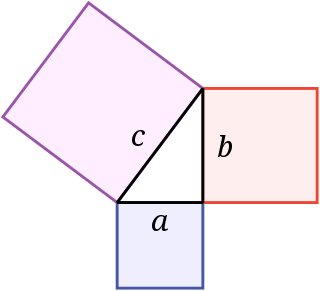
Wikimedia Commons, CC BY-SA
Related Terms
Right Triangle
A right triangle is a triangle containing exactly one right angle (90°). The side opposite the right angle is called the hypotenuse and is always the longest side, while the other two sides are called legs or catheti. Right triangles are the foundation of trigonometry and appear throughout architecture, engineering, and physics in the analysis of forces, distances, and angles.
Triangle
A triangle is a polygon with exactly three sides, three angles, and three vertices. The sum of the interior angles of any triangle always equals 180°, making it the simplest closed polygon. Triangles are the most rigid of all polygons and are widely used in engineering structures, architecture, and navigation due to their inherent stability.
Geometric Congruence
Two geometric figures are congruent if they have exactly the same shape and size, meaning one can be transformed into the other through rigid motions such as translation, rotation, or reflection without any stretching or scaling. Congruence is denoted by the symbol ≅ and is a foundational concept for proving geometric theorems and properties. It is distinct from similarity, which allows size differences while preserving shape.
Named after Pythagoras of Samos (c. 570–495 BC), a Greek mathematician and philosopher. "Theorem" comes from Greek "theorema" meaning a proposition to be proved, from "theorein" (to look at, consider). The theorem was known in Babylonian and Indian mathematics centuries before Pythagoras, but the Greeks provided a formal proof.