
Quark
Quarks are elementary subatomic particles that are the fundamental constituents of hadrons such as protons and neutrons, and are held together by the strong nuclear force via exchange of gluons in a theory called Quantum Chromodynamics (QCD). There are six types (flavours) of quarks — up, down, charm, strange, top, and bottom — each carrying a fractional electric charge of +2/3e or −1/3e and a colour charge (red, green, or blue). Quarks are permanently confined within hadrons and are never observed in isolation; a proton consists of two up quarks and one down quark (uud), while a neutron consists of one up quark and two down quarks (udd).
The Six Quark Flavours and Their Properties
| Quark | Symbol | Charge (e) | Approx. Mass (MeV/c²) | Found In |
|---|---|---|---|---|
| Up | u | +2/3 | 2.2 | Protons, neutrons |
| Down | d | −1/3 | 4.7 | Protons, neutrons |
| Charm | c | +2/3 | 1,275 | J/ψ meson, D mesons |
| Strange | s | −1/3 | 95 | Kaons, strange baryons |
| Top | t | +2/3 | 173,100 | Detected at Tevatron/LHC |
| Bottom | b | −1/3 | 4,180 | B mesons, Υ (upsilon) |
Interactive Tools
Brilliant.org: Quarks and QCD
Interactive lessons on Quantum Chromodynamics and quark interactions
Open Tool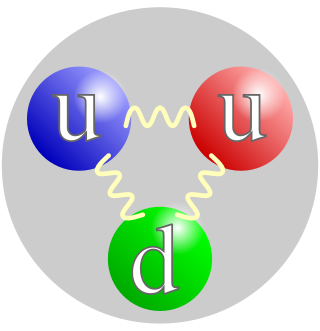
Wikimedia Commons, CC BY-SA
Related Terms
Strong Nuclear Force
The strong nuclear force is the most powerful of the four fundamental forces of nature, responsible for binding quarks together to form protons and neutrons (via the colour force mediated by gluons) and for holding protons and neutrons together within an atomic nucleus (via the residual strong force mediated by pions). It operates only at extremely short range (about 10⁻¹⁵ m, or 1 femtometre), is approximately 137 times stronger than electromagnetism at nuclear distances, and is charge-independent — it acts equally between proton-proton, proton-neutron, and neutron-neutron pairs. Without the strong force, atomic nuclei would be instantly torn apart by electrostatic repulsion between protons.
Standard Model of Particle Physics
The Standard Model of Particle Physics is the theoretical framework that describes all known fundamental particles and three of the four fundamental forces — the electromagnetic force, the weak nuclear force, and the strong nuclear force (excluding gravity). It classifies all elementary particles into fermions (quarks and leptons, which make up matter) and bosons (force-carrying particles), and predicts interactions with remarkable precision, including the existence of the Higgs boson — experimentally confirmed at CERN's Large Hadron Collider in 2012. Despite its extraordinary success, the Standard Model does not incorporate gravity, dark matter, or dark energy, and remains an incomplete description of the universe.
Antimatter
Antimatter is composed of antiparticles, each of which has the same mass as its corresponding matter particle but equal and opposite quantum numbers, such as electric charge. When a particle meets its antiparticle they annihilate each other, converting their combined rest mass entirely into energy in the form of high-energy photons (gamma rays), governed by E = mc². Predicted theoretically by Paul Dirac in 1928 and first observed by Carl Anderson in 1932 (the positron), antimatter is produced in particle accelerators, certain radioactive decays (β⁺), and natural cosmic ray interactions. It has applications in PET medical imaging and is the subject of research into the matter-antimatter asymmetry of the universe.
The word "quark" was coined by physicist Murray Gell-Mann in 1964, inspired by the phrase "Three quarks for Muster Mark!" from James Joyce's novel Finnegans Wake. Gell-Mann and George Zweig independently proposed the quark model to explain the properties of hadrons.