
Refractive Index
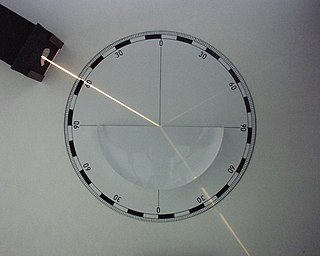
The refractive index (n) of a medium is a dimensionless number that describes how much slower light travels through that medium compared to its speed in a vacuum, defined as the ratio of the speed of light in vacuum to the speed of light in the medium. It also quantifies how much a ray of light bends (refracts) when entering the medium from vacuum, as described by Snell's Law. The refractive index determines critical phenomena such as total internal reflection, the sparkle of gemstones, and is essential in designing optical fibres, lenses, and camera systems.
Key Formula
n = c / v = sin(θ₁) / sin(θ₂)
LaTeX: n = \frac{c}{v} = \frac{\sin\theta_1}{\sin\theta_2}
| Symbol | Meaning | Unit |
|---|---|---|
| n | Refractive index | dimensionless |
| c | Speed of light in vacuum | m/s |
| v | Speed of light in the medium | m/s |
| θ₁ | Angle of incidence (in vacuum or air) | degrees |
| θ₂ | Angle of refraction (in medium) | degrees |
Worked Example
Problem
A ray of light travelling in air strikes a glass surface at an angle of incidence of 45°. The angle of refraction inside the glass is 28°. Calculate the refractive index of the glass and the speed of light inside it.
Solution
Step 1: Apply Snell's Law. n = sin(θ₁) / sin(θ₂) n = sin(45°) / sin(28°) n = 0.7071 / 0.4695 n ≈ 1.507 Step 2: Calculate speed of light in glass. v = c / n = (3 × 10⁸) / 1.507 ≈ 1.99 × 10⁸ m/s
Answer
Refractive index n ≈ 1.51; Speed in glass ≈ 1.99 × 10⁸ m/s
Refractive Indices of Common Materials at λ = 589 nm (Sodium D-line)
| Material | Refractive Index (n) | Speed in Medium (m/s) | Critical Angle (from glass) |
|---|---|---|---|
| Vacuum / Air | 1.000 | 3.00 × 10⁸ | N/A |
| Water (20°C) | 1.333 | 2.25 × 10⁸ | 48.6° |
| Crown Glass | 1.520 | 1.97 × 10⁸ | 41.1° |
| Flint Glass | 1.700 | 1.76 × 10⁸ | 36.0° |
| Diamond | 2.417 | 1.24 × 10⁸ | 24.4° |
Interactive Tools
Wikimedia Commons, CC BY-SA
Related Terms
Speed of Light
The speed of light in vacuum, denoted by c, is a universal physical constant equal to exactly 299,792,458 metres per second, representing the maximum speed at which any information, energy, or matter can travel in the universe. As established by Albert Einstein's special theory of relativity (1905), c is invariant regardless of the motion of the source or observer. In transparent media such as glass or water, light travels at a reduced speed given by v = c/n, where n is the refractive index of the medium.
Light Diffraction
Light diffraction is the bending and spreading of light waves around obstacles or through narrow openings, occurring when the size of the aperture or obstacle is comparable to the wavelength of light. It is a consequence of the wave nature of light and produces characteristic interference patterns of alternating bright and dark fringes. Diffraction is fundamental to technologies such as diffraction gratings, X-ray crystallography, CD/DVD data storage, and optical microscopy resolution limits.
Light Polarization
Light polarization is a property of transverse waves that describes the orientation of the oscillations of the electric field vector in a specific direction perpendicular to the direction of wave propagation. Unpolarized light, such as sunlight, has electric field oscillations in all directions, while polarized light has oscillations confined to a single plane. Polarization is exploited in LCD screens, polarized sunglasses, photography filters, and scientific instruments like polarimeters.
From Latin "refractus" (broken back), past participle of "refringere" (to break up), from "re-" (back) + "frangere" (to break). The term "refractive index" was introduced by Cauchy in the 19th century; Snell's Law was formulated by Willebrord Snell in 1621.