
Set Intersection
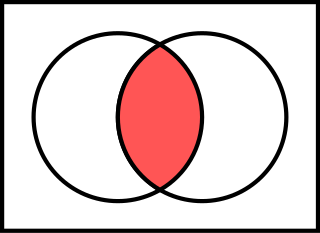
The intersection of two sets A and B is the set containing only those elements that are members of both A and B simultaneously. Written as A ∩ B, it identifies common elements shared between collections. Set intersection is used in database queries (SQL JOIN/AND), probability (joint events), and data deduplication tasks.
Key Formula
A ∩ B = { x | x is in A and x is in B }
LaTeX: A \cap B = \{ x \mid x \in A \text{ and } x \in B \}
| Symbol | Meaning | Unit |
|---|---|---|
| A | First set | set |
| B | Second set | set |
| x | An arbitrary element | element |
Worked Example
Problem
Let A = {students who play cricket} = {Arjun, Priya, Ravi, Sneha} and B = {students who play chess} = {Priya, Ravi, Deepak}. Find A ∩ B.
Solution
Step 1: Identify elements present in BOTH A and B. — Arjun: in A, not in B. — Priya: in A and in B. ✓ — Ravi: in A and in B. ✓ — Sneha: in A, not in B. — Deepak: in B, not in A. Step 2: A ∩ B = {Priya, Ravi}
Answer
A ∩ B = {Priya, Ravi} — students who play both cricket and chess.
Properties of Set Intersection
| Property | Formula | Description |
|---|---|---|
| Commutativity | A ∩ B = B ∩ A | Order does not change the result |
| Associativity | (A ∩ B) ∩ C = A ∩ (B ∩ C) | Grouping does not affect result |
| Identity | A ∩ U = A | Intersection with universal set returns A |
| Annihilation | A ∩ ∅ = ∅ | Intersection with empty set is empty |
| Idempotency | A ∩ A = A | Intersection of a set with itself is the set |
| Disjoint Sets | A ∩ B = ∅ | Sets sharing no common elements |
Interactive Tools
Wikimedia Commons, CC BY-SA
Related Terms
Set Union
The union of two sets A and B is the set containing all elements that are in A, in B, or in both, with no element repeated. Written as A ∪ B, it combines the members of both sets into a single collection. Set union is used in probability (combining events), database queries (SQL OR), and logic circuit design.
Set Theory
Set theory is the branch of mathematical logic that studies collections of objects, called sets, and the relationships between them. It provides the foundational language for nearly all of modern mathematics, defining concepts like numbers, functions, and relations in terms of sets. Developed formally by Georg Cantor in the 1870s, it underpins areas from algebra and topology to computer science and logic.
Subset
A subset is a set whose every element is also an element of another set, called the superset. If A is a subset of B (written A ⊆ B), then for every element x in A, x is also in B. The concept of subsets is fundamental to set theory and appears throughout mathematics in topics like topology, algebra, and probability theory.
From Latin "intersectio" (a cutting between), from "inter" (between) + "secare" (to cut). The symbol ∩ was also introduced by Giuseppe Peano in 1888 as a counterpart to the union symbol ∪.