
Solar System
The Solar System is the gravitationally bound system comprising the Sun and all the objects that orbit it, including eight planets, their moons, dwarf planets, asteroids, comets, and interplanetary dust. It formed approximately 4.6 billion years ago from the gravitational collapse of a giant molecular cloud. The Solar System extends from the Sun to the Oort Cloud, spanning distances of up to 100,000 astronomical units.
Key Components of the Solar System
| Component | Example | Count | Orbital Region |
|---|---|---|---|
| Star | The Sun | 1 | Centre |
| Terrestrial Planet | Earth, Mars | 4 | Inner Solar System |
| Gas Giant | Jupiter, Saturn | 2 | Outer Solar System |
| Ice Giant | Uranus, Neptune | 2 | Outer Solar System |
| Dwarf Planet | Pluto, Ceres | 5+ | Kuiper Belt / Asteroid Belt |
| Natural Satellite | Moon, Titan | 200+ | Planetary orbits |
Interactive Tools
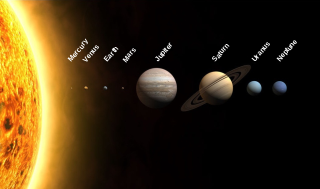
Wikimedia Commons, CC BY-SA
Related Terms
The Sun
The Sun is the star at the centre of the Solar System, a nearly perfect sphere of hot plasma that generates energy through nuclear fusion of hydrogen into helium in its core. It accounts for about 99.86% of the total mass of the Solar System and provides the light and heat essential for life on Earth. The Sun is classified as a G-type main-sequence star (G2V) with a surface temperature of approximately 5,778 K and a diameter of about 1.39 million kilometres.
Planet
A planet is a celestial body that orbits a star, has sufficient mass for its self-gravity to overcome rigid body forces so that it assumes a nearly round shape, and has cleared the neighbourhood around its orbit of other debris. The International Astronomical Union (IAU) formalised this definition in 2006, which reclassified Pluto as a dwarf planet. There are eight recognised planets in our Solar System, divided into terrestrial (rocky) planets and giant (gaseous or icy) planets.
Planetary Orbit
A planetary orbit is the curved path followed by a planet as it moves around the Sun (or another star) under the influence of gravitational attraction. According to Kepler's First Law, planetary orbits are ellipses with the Sun at one of the two foci. The shape of an orbit is described by its eccentricity, where 0 represents a perfect circle and values approaching 1 represent highly elongated ellipses.
From Latin "solaris" (of the sun, from "sol" meaning sun) and "systema" (from Greek "systema", an organised whole). The term came into common use in the 17th century after Copernicus established the heliocentric model.