
t-Distribution
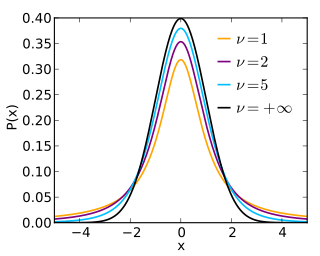
The t-distribution (Student's t-distribution) is a continuous probability distribution that arises when estimating the mean of a normally distributed population when the sample size is small and the population standard deviation is unknown. It has heavier tails than the normal distribution, reflecting greater uncertainty; as the degrees of freedom increase toward infinity, it converges to the standard normal distribution. It is the foundation of t-tests and is central to small-sample statistical inference.
Key Formula
t = (x̄ − μ) / (s / √n)
LaTeX: t = \dfrac{\bar{x} - \mu}{s / \sqrt{n}}
| Symbol | Meaning | Unit |
|---|---|---|
| \bar{x} | Sample mean | same as data |
| μ | Population mean (null hypothesis value) | same as data |
| s | Sample standard deviation | same as data |
| n | Sample size | count |
Worked Example
Problem
A sample of 10 light bulbs has a mean lifetime of 1 050 hours with s = 80 hours. Test whether the true mean differs from 1 000 hours.
Solution
Step 1: x̄ = 1 050, μ₀ = 1 000, s = 80, n = 10. Step 2: t = (1 050 − 1 000) / (80 / √10) = 50 / 25.298 ≈ 1.976. Step 3: Degrees of freedom = n − 1 = 9. Step 4: Critical t₀.₀₅(9) (two-tailed) ≈ 2.262. Step 5: |1.976| < 2.262, so we fail to reject H₀.
Answer
t ≈ 1.976, df = 9; insufficient evidence to reject μ = 1 000 hours at α = 0.05
Critical t-values for Two-Tailed Tests at α = 0.05
| Degrees of Freedom | Critical t (α=0.05) | Critical t (α=0.01) | Converges to Z |
|---|---|---|---|
| 1 | 12.706 | 63.657 | No |
| 5 | 2.571 | 4.032 | No |
| 10 | 2.228 | 3.169 | Approaching |
| 30 | 2.042 | 2.750 | Approximately |
| 100 | 1.984 | 2.626 | Approximately |
| ∞ | 1.960 | 2.576 | Yes (= Z) |
Interactive Tools
Wikimedia Commons, CC BY-SA
Related Terms
Z-score
A Z-score (also called a standard score) measures how many standard deviations a data point is from the mean of its distribution. It standardises values from different distributions, enabling direct comparison by placing them on a common scale. Z-scores are widely used in quality control, hypothesis testing, and the construction of standard normal tables.
Hypothesis Testing
Hypothesis testing is a formal statistical procedure for making decisions about a population parameter based on sample data, by evaluating evidence against a null hypothesis (H₀) in favour of an alternative hypothesis (H₁). A test statistic is computed and compared to a critical value or converted to a p-value; if the result is statistically significant (p < α), the null hypothesis is rejected. It underpins scientific research, clinical trials, quality assurance, and data-driven decision-making across all quantitative disciplines.
Confidence Interval
A confidence interval (CI) is a range of plausible values for an unknown population parameter, constructed from sample data so that the procedure captures the true parameter with a specified probability (the confidence level, e.g., 95%). Crucially, the confidence level refers to the long-run success rate of the procedure — not the probability that a particular interval contains the parameter. Confidence intervals are used throughout science, medicine, and engineering to quantify estimation uncertainty.
Published in 1908 by William Sealy Gosset under the pen name "Student" to hide his employment at Guinness Brewery. The letter "t" was used by Gosset in his original paper; Ronald Fisher later formalised the distribution's name as the "Student t-distribution".