
Action Potential
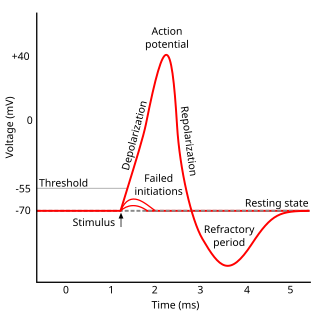
An action potential is a rapid, transient, self-propagating electrical signal in a neuron or muscle cell generated by the sequential opening and closing of voltage-gated ion channels, causing a characteristic depolarization followed by repolarization of the cell membrane. The membrane potential briefly shifts from approximately −70 mV (resting) to +40 mV (peak) before returning to resting levels, following an all-or-none principle in which the stimulus must reach a threshold of around −55 mV to trigger the full response. Action potentials propagate along axons without signal loss and serve as the primary mode of long-distance communication in the nervous system.
Key Formula
Vm = (RT/F) × ln( (PK·[K+]o + PNa·[Na+]o + PCl·[Cl-]i) / (PK·[K+]i + PNa·[Na+]i + PCl·[Cl-]o) )
LaTeX: V_m = \frac{RT}{F} \ln\left(\frac{P_K[K^+]_o + P_{Na}[Na^+]_o + P_{Cl}[Cl^-]_i}{P_K[K^+]_i + P_{Na}[Na^+]_i + P_{Cl}[Cl^-]_o}\right)
| Symbol | Meaning | Unit |
|---|---|---|
| Vm | Membrane potential | Volts (V) |
| R | Universal gas constant | J mol⁻¹ K⁻¹ |
| T | Absolute temperature | Kelvin (K) |
| F | Faraday's constant | C mol⁻¹ |
| P_K, P_Na, P_Cl | Permeabilities of K⁺, Na⁺, Cl⁻ ions | Dimensionless ratio |
| [X]o / [X]i | Extracellular / intracellular ion concentrations | mM |
Worked Example
Problem
A neuron at rest has a resting membrane potential of −70 mV. If a stimulus depolarizes the membrane to the threshold of −55 mV, describe the sequence of events during an action potential and calculate the total voltage swing from resting potential to peak.
Solution
Step 1: At rest, Vm = −70 mV. Stimulus brings Vm to threshold = −55 mV. Step 2: Voltage-gated Na⁺ channels open → Na⁺ rushes in (high extracellular concentration ~145 mM vs ~12 mM inside). Step 3: Rapid depolarization occurs; Vm rises to peak ≈ +40 mV. Step 4: Na⁺ channels inactivate; voltage-gated K⁺ channels open → K⁺ rushes out. Step 5: Repolarization: Vm falls back toward −70 mV. Step 6: Brief hyperpolarization (undershoot) to ~−80 mV before K⁺ channels close. Voltage swing = Peak − Resting = +40 mV − (−70 mV) = 110 mV.
Answer
Total voltage swing = 110 mV (from −70 mV resting to +40 mV peak).
Phases of the Action Potential
| Phase | Membrane Potential | Ion Channel Event | Duration |
|---|---|---|---|
| Resting | −70 mV | Leak K⁺ channels open; Na⁺/K⁺-ATPase active | Indefinite until stimulus |
| Depolarization | −70 mV → +40 mV | Voltage-gated Na⁺ channels open | ~1 ms |
| Repolarization | +40 mV → −70 mV | Na⁺ channels inactivate; K⁺ channels open | ~1–2 ms |
| Hyperpolarization | −70 mV → −80 mV | K⁺ channels still open (overshoot) | ~1 ms |
| Absolute refractory | Variable | Na⁺ channels inactivated, cannot fire | ~1–2 ms |
| Relative refractory | Near resting | Na⁺ channels recovering; higher threshold | ~2–4 ms |
Interactive Tools
Wikimedia Commons, CC BY-SA
Related Terms
Synapse
A synapse is the specialized junction between two neurons, or between a neuron and a target cell such as a muscle or gland, across which nerve impulses are transmitted via chemical neurotransmitters or direct electrical coupling. In a chemical synapse, an action potential in the presynaptic neuron triggers the release of neurotransmitters from synaptic vesicles into the synaptic cleft, where they bind to receptors on the postsynaptic membrane and alter its excitability. Synaptic strength can be modified through processes of long-term potentiation (LTP) and long-term depression (LTD), which are thought to underlie learning and memory.
Neuron
A neuron is the fundamental structural and functional unit of the nervous system, specialized for receiving, processing, and transmitting electrochemical signals. Each neuron consists of a cell body (soma), dendrites that receive incoming signals, and an axon that transmits signals away to other neurons, muscles, or glands. The human brain contains approximately 86 billion neurons, and the precise connectivity and signaling between them underlies all cognitive processes, sensory perception, and motor control.
Homeostasis
Homeostasis is the tendency of biological systems to maintain relatively stable internal conditions despite changes in the external environment, achieved through a series of regulatory feedback mechanisms. It operates primarily through negative feedback loops in which deviations from a set point trigger corrective responses to restore equilibrium. Maintaining homeostasis is essential for survival, as critical variables such as body temperature (37°C in humans), blood glucose (70–100 mg/dL), and blood pH (7.35–7.45) must be kept within narrow physiological ranges.
From Latin "actio" (action, doing) and "potentia" (power, potential). The ionic basis of the action potential was elucidated by Alan Hodgkin and Andrew Huxley in their landmark 1952 papers on the squid giant axon, for which they received the Nobel Prize in Physiology or Medicine in 1963.