
Synapse
A synapse is the specialized junction between two neurons, or between a neuron and a target cell such as a muscle or gland, across which nerve impulses are transmitted via chemical neurotransmitters or direct electrical coupling. In a chemical synapse, an action potential in the presynaptic neuron triggers the release of neurotransmitters from synaptic vesicles into the synaptic cleft, where they bind to receptors on the postsynaptic membrane and alter its excitability. Synaptic strength can be modified through processes of long-term potentiation (LTP) and long-term depression (LTD), which are thought to underlie learning and memory.
Chemical vs Electrical Synapse Comparison
| Feature | Chemical Synapse | Electrical Synapse |
|---|---|---|
| Signal carrier | Neurotransmitter molecules | Ionic current through gap junctions |
| Synaptic delay | 0.5–5 milliseconds | Nearly instantaneous |
| Signal direction | Unidirectional | Bidirectional (usually) |
| Modifiability | Highly plastic (LTP/LTD) | Less modifiable |
| Amplification | Possible | Not possible |
| Location | Most CNS and PNS synapses | Heart muscle, some brain regions |
Interactive Tools
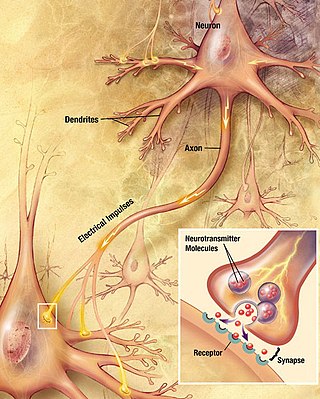
Wikimedia Commons, CC BY-SA
Related Terms
Neuron
A neuron is the fundamental structural and functional unit of the nervous system, specialized for receiving, processing, and transmitting electrochemical signals. Each neuron consists of a cell body (soma), dendrites that receive incoming signals, and an axon that transmits signals away to other neurons, muscles, or glands. The human brain contains approximately 86 billion neurons, and the precise connectivity and signaling between them underlies all cognitive processes, sensory perception, and motor control.
Action Potential
An action potential is a rapid, transient, self-propagating electrical signal in a neuron or muscle cell generated by the sequential opening and closing of voltage-gated ion channels, causing a characteristic depolarization followed by repolarization of the cell membrane. The membrane potential briefly shifts from approximately −70 mV (resting) to +40 mV (peak) before returning to resting levels, following an all-or-none principle in which the stimulus must reach a threshold of around −55 mV to trigger the full response. Action potentials propagate along axons without signal loss and serve as the primary mode of long-distance communication in the nervous system.
Nervous System
The nervous system is the organ system that coordinates voluntary and involuntary actions and transmits signals between different parts of the body using a network of neurons. In vertebrates it is divided into the central nervous system (CNS), comprising the brain and spinal cord, and the peripheral nervous system (PNS), comprising all neural tissue outside the CNS. The nervous system integrates sensory information, processes it, and generates appropriate motor or physiological responses, making it central to behavior, cognition, and homeostasis.
From Greek "synapsis" (conjunction, connection), derived from "synaptein" (to clasp together, to fasten). The term was introduced by English physiologist Charles Scott Sherrington in 1897 to describe the specialized junction between neurons.