
Feedback Control
Feedback control is a control strategy in which the output of a system is measured and compared to a desired reference (setpoint), and the difference (error) is used to adjust the system input to reduce that error. Negative feedback — where the output is subtracted from the reference — is the basis of stable automatic control systems in engineering, biology, and economics. Feedback control enables systems to self-correct against disturbances and parameter variations, forming the foundation of servo systems, thermostats, autopilots, and industrial process control.
Open-Loop vs Closed-Loop (Feedback) Control Systems
| Feature | Open-Loop Control | Closed-Loop (Feedback) Control |
|---|---|---|
| Error correction | None — no measurement of output | Continuous — error drives input |
| Disturbance rejection | Poor | Good |
| Complexity | Simple, low cost | More complex, higher cost |
| Stability risk | Always stable (if designed right) | Can become unstable if gain too high |
| Accuracy | Limited by calibration | High — self-correcting |
| Example | Toaster timer | Thermostat, cruise control |
Interactive Tools
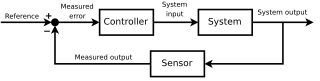
Wikimedia Commons, CC BY-SA
Related Terms
Transfer Function (control)
A transfer function is the ratio of the Laplace transform of the output to the Laplace transform of the input of a linear time-invariant (LTI) system, assuming zero initial conditions. It fully characterises a system's dynamic behaviour in the frequency domain, including its poles, zeros, gain, and stability margins. Transfer functions are the central tool in classical control theory for designing feedback controllers, analysing stability using root locus and Bode plots, and predicting transient and steady-state responses.
PID Controller
A PID (Proportional-Integral-Derivative) controller is a feedback control mechanism that calculates a control output based on three terms: the proportional term (current error), the integral term (accumulated past error), and the derivative term (rate of change of error). Together these three components allow the controller to eliminate steady-state error, respond rapidly to disturbances, and suppress oscillations. PID controllers are the most widely used feedback controllers in industrial automation, motor drives, temperature regulation, and robotic systems due to their effectiveness and relative simplicity of tuning.
Laplace Transform
The Laplace Transform converts a time-domain function into the complex frequency domain (s-domain), enabling differential equations to be solved as algebraic equations. It generalises the Fourier Transform by including a real exponential damping term, making it applicable to a broader class of signals including those that grow with time. It is the primary mathematical tool in control systems engineering, circuit analysis, and linear system theory for analysing stability, transient response, and frequency behaviour.
The word "feedback" was introduced into engineering by Harold Black at Bell Labs in 1927, when he invented the negative feedback amplifier. "Feed" derives from Old English "fedan" and "back" reflects the signal returning to the input. The mathematical theory of feedback was formalised by Norbert Wiener in his 1948 book "Cybernetics," which unified feedback control principles across engineering, biology, and social systems.