
Interphase
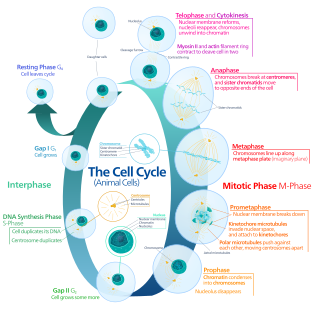
Interphase is the longest phase of the cell cycle, during which the cell grows, replicates its DNA, and prepares for division. It is divided into three subphases: G1 (first gap), in which the cell grows and synthesizes proteins; S phase (synthesis), in which DNA replication occurs; and G2 (second gap), in which the cell continues to grow and prepares the machinery for mitosis. Despite appearing inactive under a microscope, interphase is metabolically the most active period of a cell's life.
Subphases of Interphase
| Subphase | Full Name | Key Activity | DNA Content (human) |
|---|---|---|---|
| G1 | First Gap | Cell growth, protein synthesis | 2n (46 chromosomes) |
| S | Synthesis | DNA replication | 2n → 4n (replicating) |
| G2 | Second Gap | Growth, organelle duplication | 4n (92 chromatids) |
| G0 | Quiescent state | Cell exits cycle (some cells) | 2n |
Interactive Tools
Wikimedia Commons, CC BY-SA
Related Terms
Mitosis
Mitosis is the process of nuclear division in eukaryotic cells that produces two genetically identical daughter nuclei, each containing the same chromosome number as the parent cell. It is the primary mechanism of growth, tissue repair, and asexual reproduction in multicellular organisms. Mitosis proceeds through four sequential stages — prophase, metaphase, anaphase, and telophase — before the cytoplasm divides in cytokinesis.
Cytokinesis
Cytokinesis is the physical process of cytoplasmic division that follows telophase and separates the two daughter nuclei into two distinct cells. In animal cells, a contractile ring of actin and myosin filaments forms a cleavage furrow that pinches inward until the cell splits. In plant cells, a cell plate grows outward from the center of the cell toward the plasma membrane, eventually forming a new cell wall between the two daughter cells.
Centromere
The centromere is a specialized DNA sequence on a chromosome that serves as the attachment point for the kinetochore, the protein complex that connects chromosomes to spindle fibers during cell division. It holds sister chromatids together after DNA replication until they are separated during anaphase. The position of the centromere determines chromosome shape and is used in chromosome classification: chromosomes may be metacentric (central), submetacentric, acrocentric, or telocentric based on centromere location.
From Latin "inter" meaning between and Greek "phasis" meaning appearance; named because it occurs between two successive mitotic divisions, though it was originally (incorrectly) thought to be a resting phase.