
Mitosis
Mitosis is the process of nuclear division in eukaryotic cells that produces two genetically identical daughter nuclei, each containing the same chromosome number as the parent cell. It is the primary mechanism of growth, tissue repair, and asexual reproduction in multicellular organisms. Mitosis proceeds through four sequential stages — prophase, metaphase, anaphase, and telophase — before the cytoplasm divides in cytokinesis.
Comparison of Mitosis Stages
| Stage | Key Events | Chromosome Behavior | Duration (approx.) |
|---|---|---|---|
| Prophase | Chromatin condenses, spindle forms | Chromosomes become visible | Variable |
| Metaphase | Chromosomes align at cell plate | Lined up at metaphase plate | Short |
| Anaphase | Sister chromatids separate | Move to opposite poles | Brief |
| Telophase | Nuclear envelopes reform | Chromosomes decondense | Variable |
| Cytokinesis | Cytoplasm divides | Two complete cells form | Variable |
Interactive Tools
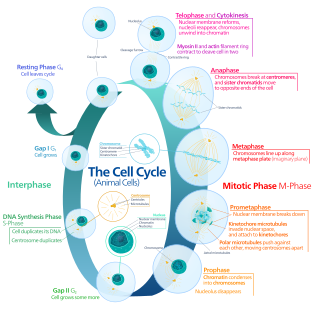
Wikimedia Commons, CC BY-SA
Related Terms
Meiosis
Meiosis is a specialized form of cell division that reduces the chromosome number by half, producing four genetically unique haploid daughter cells from a single diploid parent cell. It is essential for sexual reproduction, generating gametes (sperm and egg cells) in animals and spores in plants and fungi. Genetic diversity is introduced through two key events: crossing over during prophase I and independent assortment of homologous chromosomes.
Interphase
Interphase is the longest phase of the cell cycle, during which the cell grows, replicates its DNA, and prepares for division. It is divided into three subphases: G1 (first gap), in which the cell grows and synthesizes proteins; S phase (synthesis), in which DNA replication occurs; and G2 (second gap), in which the cell continues to grow and prepares the machinery for mitosis. Despite appearing inactive under a microscope, interphase is metabolically the most active period of a cell's life.
Cytokinesis
Cytokinesis is the physical process of cytoplasmic division that follows telophase and separates the two daughter nuclei into two distinct cells. In animal cells, a contractile ring of actin and myosin filaments forms a cleavage furrow that pinches inward until the cell splits. In plant cells, a cell plate grows outward from the center of the cell toward the plasma membrane, eventually forming a new cell wall between the two daughter cells.
From Greek "mitos" meaning thread, coined by Walther Flemming in 1882 to describe the thread-like appearance of chromosomes during division.