
Quantum Mechanics
Quantum mechanics is the fundamental theory of physics that describes the behaviour of matter and energy at the scale of atoms and subatomic particles, where classical Newtonian mechanics breaks down. It introduces concepts such as quantisation of energy, wave-particle duality, and the probabilistic nature of physical observables. Quantum mechanics underpins modern technologies including semiconductors, lasers, MRI machines, and quantum computing.
Quantum Mechanics vs Classical Mechanics
| Feature | Classical Mechanics | Quantum Mechanics |
|---|---|---|
| Energy | Continuous values | Discrete (quantised) values |
| Position/Momentum | Exactly determinable | Governed by uncertainty principle |
| Particle nature | Definite particle | Wave-particle duality |
| Prediction type | Deterministic | Probabilistic |
| Scale | Macroscopic objects | Atomic and subatomic |
| Governing equation | Newton's laws | Schrödinger equation |
Interactive Tools
PhET Quantum Simulations
Interactive simulations for quantum phenomena including photoelectric effect and wave functions
Open ToolKhan Academy – Quantum Physics
Structured lessons and videos on foundational quantum mechanics concepts
Open ToolBrilliant – Quantum Mechanics
Problem-based learning course covering quantum mechanics from first principles
Open Tool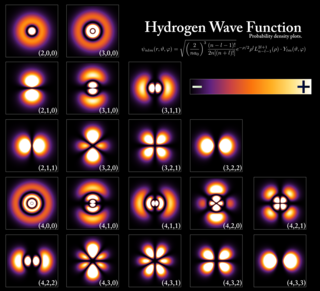
Wikimedia Commons, CC BY-SA
Related Terms
Wave-Particle Duality
Wave-particle duality is the quantum mechanical principle stating that every quantum entity, such as an electron or photon, exhibits both wave-like and particle-like properties depending on how it is observed or measured. In experiments such as the double-slit experiment, particles produce interference patterns characteristic of waves when not observed, but behave as localized particles when detected at specific positions. This duality is central to quantum mechanics and demonstrates that classical concepts of "wave" and "particle" are complementary rather than contradictory descriptions of quantum objects.
Schrödinger Equation
The Schrödinger equation is the fundamental equation of motion in non-relativistic quantum mechanics, describing how the quantum state (wave function) of a physical system evolves over time. Its time-independent form is used to find the allowed energy levels and stationary states of quantum systems such as atoms and molecules. Solutions to the Schrödinger equation yield wave functions from which all measurable properties of a quantum system, including energy eigenvalues, transition probabilities, and electron densities, can be derived.
Heisenberg Uncertainty Principle
The Heisenberg Uncertainty Principle states that it is fundamentally impossible to simultaneously determine both the exact position and exact momentum of a quantum particle with arbitrary precision; the more precisely one is known, the less precisely the other can be known. This is not a limitation of measurement instruments but an intrinsic property of quantum systems arising from the wave nature of matter. A complementary relation exists between energy and time, and the principle has profound implications for atomic stability, electron orbitals, and the zero-point energy of quantum systems.
From Latin "quantum" meaning "how much" or "a discrete amount", coined by Max Planck in 1900 to describe energy packets. The word "mechanics" derives from Greek "mēkhanikē" (art of machines). The term "quantum mechanics" was formalised by Werner Heisenberg and others in the 1920s.