
Wave-Particle Duality
Wave-particle duality is the quantum mechanical principle stating that every quantum entity, such as an electron or photon, exhibits both wave-like and particle-like properties depending on how it is observed or measured. In experiments such as the double-slit experiment, particles produce interference patterns characteristic of waves when not observed, but behave as localized particles when detected at specific positions. This duality is central to quantum mechanics and demonstrates that classical concepts of "wave" and "particle" are complementary rather than contradictory descriptions of quantum objects.
Wave vs Particle Behaviour of Quantum Entities
| Property | Wave Behaviour | Particle Behaviour | Experiment |
|---|---|---|---|
| Propagation | Spreads through space | Travels as a point | Double-slit setup |
| Interaction | Interference and diffraction | Discrete collision | Electron diffraction |
| Detection | Distributed pattern | Single spot on detector | Photographic plate |
| Energy exchange | Continuous | Discrete quanta | Photoelectric effect |
| Description | Wavelength, frequency | Mass, momentum | Compton scattering |
Interactive Tools
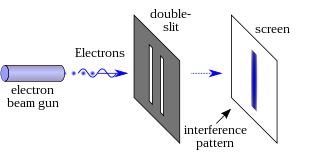
Wikimedia Commons, CC BY-SA
Related Terms
Photon
A photon is a massless elementary particle and the quantum of electromagnetic radiation, carrying energy proportional to its frequency. It is the force-carrier particle for the electromagnetic force and travels at the speed of light in a vacuum. Photons exhibit both wave and particle behaviour and are fundamental to understanding light-matter interactions, including the photoelectric effect, atomic emission spectra, and optical technologies.
de Broglie Wavelength
The de Broglie wavelength is the wavelength associated with any moving particle, expressing the wave-like nature of matter as proposed by Louis de Broglie in 1924. It is inversely proportional to the momentum of the particle, meaning heavier or faster-moving objects have shorter wavelengths and thus exhibit negligible quantum wave behaviour. This concept was experimentally confirmed by electron diffraction experiments and forms the basis for electron microscopy and quantum confinement in nanomaterials.
Quantum Mechanics
Quantum mechanics is the fundamental theory of physics that describes the behaviour of matter and energy at the scale of atoms and subatomic particles, where classical Newtonian mechanics breaks down. It introduces concepts such as quantisation of energy, wave-particle duality, and the probabilistic nature of physical observables. Quantum mechanics underpins modern technologies including semiconductors, lasers, MRI machines, and quantum computing.
The concept emerged from the wave theory of light (Huygens, 1678) and Einstein's particle theory of photons (1905). Louis de Broglie extended duality to matter in 1924. The term "wave-particle duality" became standard in quantum physics literature of the 1920s–1930s.